
The term "dowel pin" is used loosely to describe any cylindrical pin used to locate or retain components - but the three main types (solid, spring, and spiral) work on entirely different principles and are suited to very different applications. Choosing the wrong type can result in poor positional accuracy, difficulty in assembly, or premature failure under dynamic loading.
Solid Dowel Pin (ISO 8734)
A solid dowel pin is a precision-ground, through-hardened cylinder - typically case-hardened steel or stainless steel - with chamfered ends to aid insertion. It is the original dowel pin, and the most widely used wherever accurate, repeatable positional location is required.
Governed by ISO 8734 (formerly DIN 6325), solid dowel pins are manufactured to tight diameter tolerances:
- Tolerance h6 - used for press-fit into a reamed H7 hole, giving a transition fit. The pin can be removed with a drift if required.
- Tolerance m6 - used for a permanent interference fit where the pin must never move relative to one of the components.
The mating hole must be reamed, not drilled. A drilled hole lacks the diameter accuracy and surface finish needed to achieve the correct fit - the pin will either be loose or impossible to insert.
Where solid dowel pins excel
- Jig and fixture alignment - two or more components that must be re-assembled to within microns, repeatedly
- Mould and die alignment - mould halves, die sets, press tooling where every tenth of a millimetre matters
- Machine element location - gearbox covers, pump bodies, split bearing housings
- Anti-rotation in bolted joints - preventing flanges and covers from rotating under torque
Key characteristic: Solid dowel pins are rigid and precise. They provide the tightest positional accuracy of any pin type but require reamed holes and careful press-fit installation. They are not designed to flex or absorb shock.
Spring Dowel Pin - Slotted (ISO 8752)
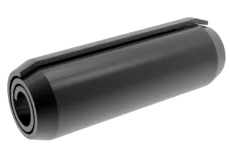
A spring pin (also called a slotted pin, roll pin, or split pin in informal usage) is a hollow cylinder with a longitudinal slot running the full length. During insertion, the pin compresses radially; once seated, it springs back to grip the hole walls, providing its own retention without any adhesive or special fit.
Governed by ISO 8752 (formerly DIN 1481), spring pins are made in two duty series:
- Light duty - thinner wall, easier insertion, suitable for light loads and non-critical retention
- Heavy duty - thicker wall, higher shear strength, used in structural applications and agricultural/construction equipment
Where spring pins excel
- Through-holes that are difficult to ream - spring pins tolerate looser hole tolerances than solid pins
- Applications requiring easy field removal - the pin can be driven out with a punch and reused
- Hinge and pivot pins - light-duty pivots in linkages, handles, latches
- Anti-rotation on shafts - preventing gears, collars, and couplings from rotating when alignment is not critical
Key characteristic: Spring pins are self-retaining and tolerant of looser holes. They sacrifice positional precision for ease of installation and removal. The single slot creates a stress concentration - under repeated dynamic loading, slotted spring pins can fatigue and crack.
Spiral Dowel Pin (ISO 8750)
A spiral pin (also called a coiled pin or roll pin with coiled construction) is manufactured by coiling a flat metal strip into a multi-layer cylinder. Like a spring pin, it compresses on insertion and self-retains - but the coiled construction distributes stress uniformly around the circumference rather than concentrating it at a slot.
Governed by ISO 8750, spiral pins are available in light, standard, and heavy duty.
Where spiral pins excel
- High vibration and shock load environments - the coil construction absorbs energy, resists fatigue cracking
- Repeated insertion and removal cycles - the pin retains its grip far longer than a slotted pin under cyclic loading
- Applications where noise must be minimised - the coil dampens vibration transmission
- Agricultural, mining, and construction machinery - where dynamic loads and contamination are unavoidable
Key characteristic: Spiral pins are the premium version of the elastic pin concept. They cost more than slotted spring pins but offer significantly better fatigue life under dynamic loading. If a slotted pin is failing prematurely in your application, a spiral pin in the same hole size is the first upgrade to try.
Side-by-Side Comparison
| Property | Solid Pin (ISO 8734) | Spring Pin (ISO 8752) | Spiral Pin (ISO 8750) |
|---|---|---|---|
| Construction | Solid ground cylinder | Slotted hollow tube | Coiled strip cylinder |
| Standard | ISO 8734 / DIN 6325 | ISO 8752 / DIN 1481 | ISO 8750 |
| Self-retaining | No - requires interference fit | Yes - radial spring force | Yes - radial spring force |
| Positional accuracy | Very high (h6/m6 tolerance) | Low - slot allows variation | Low - coil allows variation |
| Hole requirement | Reamed (H7) | Drilled or reamed | Drilled or reamed |
| Shock/fatigue resistance | Low - rigid, brittle under impact | Moderate - single slot fatigues | High - coil distributes stress |
| Removability | Moderate - requires drift/press | Easy - drive out with punch | Easy - drive out with punch |
| Relative cost | Medium | Low | Medium-high |
How to Choose
Use this decision framework:
- Positional accuracy is critical (fixtures, moulds, precision assemblies)? → Solid dowel pin (ISO 8734, h6 tolerance)
- Static load, easy assembly/disassembly, drilled holes? → Spring pin (ISO 8752, light duty)
- Heavy static load in a drilled hole? → Spring pin (ISO 8752, heavy duty)
- Dynamic load, vibration, or shock? → Spiral pin (ISO 8750)
- Repeated removal and re-insertion under load? → Spiral pin (ISO 8750)
- Slotted spring pin failing prematurely? → Upgrade to spiral pin in the same hole
Need Dowel Pins for Your Application?
We stock solid dowel pins (ISO 8734), spring pins (ISO 8752), and spiral pins (ISO 8750) in carbon steel and stainless steel, dispatched from Mumbai with same-week delivery across India.
View Dowel Pin RangeFrequently Asked Questions
What is the difference between a solid dowel pin and a spring pin?
A solid dowel pin (ISO 8734, h6 tolerance) is a precision-ground cylinder used for accurate, repeatable component location - it requires a reamed hole. A spring pin (ISO 8752) is a hollow slotted tube that compresses on insertion and self-retains by radial spring force - it tolerates looser holes but cannot achieve the same positional accuracy as a solid pin.
Can a spring pin be used for precision location?
Not reliably. The longitudinal slot in a spring pin allows its diameter to vary under load, so it does not provide the same positional repeatability as a solid ground pin. For jigs, fixtures, or mould tools where hole-to-hole alignment is critical, a solid dowel pin with h6 tolerance is the correct choice.
What is a spiral dowel pin and how does it differ from a spring pin?
A spiral (coiled) pin is made by coiling a flat metal strip into a multi-layer cylinder (ISO 8750). The coiled construction distributes radial stress uniformly - unlike a slotted spring pin where stress concentrates at the slot. Spiral pins offer significantly better fatigue resistance under dynamic loading, vibration, and repeated insertion-removal cycles.
What tolerance is a standard solid dowel pin?
ISO 8734 solid dowel pins are manufactured to h6 tolerance for a press-fit into a reamed H7 hole (transition fit, removable). An m6 tolerance gives a tighter interference fit for permanent installation. The mating hole must be reamed - a drilled hole will not provide the accuracy or finish needed for a correct fit.