Shaft keys transmit torque between a shaft and a hub - gear, pulley, coupling, or sprocket - by sitting in matching keyways cut into both components. A parallel machine key and a Woodruff key look different, behave differently, and suit different situations. Using the wrong type causes keyway fretting, fatigue failure, or shaft fracture.
Parallel (Machine) Key - DIN 6885
A parallel key (also called a machine key or feather key) is a rectangular or square prismatic bar. It fits into a straight keyway milled along the axis of a cylindrical shaft, and an identical straight keyway in the bore of the mating hub. Torque is transmitted by the key bearing against the side walls of both keyways.
Governed by DIN 6885, parallel keys come in three end forms:
- Form A - both ends radius (round-ended): most common, matches an end-mill pocket directly
- Form B - both ends flat (square): used where the keyway is broached or when the key must sit flush with a shaft shoulder
- Form C - one end radius, one end flat: a hybrid for specific installation constraints
Key dimensions (width × height) are standardised against shaft diameter - a 30 mm shaft takes an 8 × 7 mm key. The shaft keyway fit is typically JS9 or P9 (close/interference); the hub keyway is D10 clearance for sliding (feather key) or JS9 for a fixed hub.
Where parallel keys excel
- High-torque drives - gearboxes, couplings, chain sprockets, large pulleys
- Sliding fits (feather keys) - when the hub must be able to move axially on the shaft (sliding gear selectors, variable-speed drives)
- Long engagement length - the key can be made as long as the available shaft length, distributing load over a large area
- Cylindrical shafts of any diameter - standardised from Ø6 mm to Ø500 mm
Key characteristic: Parallel keys offer the highest torque capacity of any key type. The straight keyway runs along the shaft axis - installation, removal, and engagement length adjustment are all straightforward.
Woodruff Key - DIN 6888
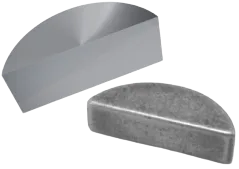
A Woodruff key is a semicircular disc - like a coin cut in half. It sits in a curved pocket milled into the shaft (using a Woodruff cutter) and protrudes above the shaft surface into a straight keyway in the hub. Because the key sits in a curved pocket rather than a straight slot, it can tilt slightly to self-align with the hub keyway.
Governed by DIN 6888, Woodruff keys are identified by their width and diameter (e.g., 5 × 16 mm: 5 mm wide, 16 mm disc diameter). The depth of the pocket in the shaft is significant - it must accommodate the full lower semicircle, which cuts deep into the shaft cross-section.
Where Woodruff keys excel
- Tapered shaft ends - the self-aligning feature allows the key to seat correctly even as the hub is driven axially onto the taper
- Small shaft diameters with short hubs - the Woodruff key is compact and needs minimal axial engagement length
- Machine tool spindles and tapered couplings - where the hub must be positioned precisely on a taper and self-alignment matters
- Light-to-medium torque applications - handwheels, small pulleys, camshafts, pump impellers
Key characteristic: The Woodruff key's only advantage is self-alignment on tapered shafts. Its deep curved pocket significantly weakens the shaft - for the same diameter, a Woodruff joint is always weaker in torsion than a parallel key joint.
Side-by-Side Comparison
| Property | Parallel (Machine) Key | Woodruff Key |
|---|---|---|
| Profile | Rectangular/square prismatic | Semicircular disc |
| Standard | DIN 6885 (Forms A, B, C) | DIN 6888 |
| Shaft keyway shape | Straight (milled along axis) | Curved pocket (Woodruff cutter) |
| Hub keyway shape | Straight | Straight |
| Self-aligning | No | Yes - key can tilt in pocket |
| Shaft type | Cylindrical | Cylindrical or tapered |
| Torque capacity | High | Low to medium |
| Shaft weakening | Moderate (shallow keyway) | High (deep curved pocket) |
| Axial sliding (feathering) | Yes (clearance fit in hub) | No |
| Typical applications | Gears, couplings, sprockets, pumps | Tapered shaft ends, handwheels, spindles |
Torque Capacity and Failure Modes
Both key types transmit torque through bearing stress on the key's side faces. The torque capacity depends on: key width, key engagement length in the hub, yield strength of the key material, and the hub wall thickness bearing against the key.
Parallel keys fail by:
- Fretting corrosion - micro-movement between key and keyway sides under cyclic loading causes oxide debris and surface damage
- Keyway fatigue cracking - the keyway is a stress concentrator; the shaft can crack from the keyway corner under bending + torsion
- Shear through the key - rare in properly sized keys; indicates the key was undersized or the wrong material
Woodruff keys additionally risk:
- Shaft fracture through the pocket - the deep curved pocket creates a significantly larger stress concentration than a straight keyway, especially under combined bending and torsion loads
How to Choose
- Cylindrical shaft, medium-to-high torque? → Parallel key (DIN 6885), size per shaft diameter table
- Tapered shaft end? → Woodruff key (DIN 6888) - its self-aligning feature is essential here
- Hub needs to slide axially on the shaft? → Parallel key with clearance fit in hub keyway (feather key)
- Compact installation, short hub, light torque? → Woodruff key if tapered, parallel key Form B if cylindrical
- High-fatigue or reversing torque application? → Parallel key, and consider spline or interference fit as alternatives if fatigue is a concern
Need Machine Keys or Woodruff Keys?
We stock parallel keys (DIN 6885, Forms A/B/C) and Woodruff keys (DIN 6888) in carbon steel and stainless steel, across a full range of sizes, dispatched from Mumbai with same-week delivery across India.
View Fastener & Key RangeFrequently Asked Questions
What is the difference between a machine key and a Woodruff key?
A machine (parallel) key is a rectangular bar fitting into straight keyways in both shaft and hub - it is used on cylindrical shafts and offers high torque capacity. A Woodruff key is a semicircular disc sitting in a curved pocket in the shaft - it self-aligns with the hub keyway and is suited to tapered shaft ends, but has lower torque capacity due to the deep pocket weakening the shaft.
Why is a Woodruff key used on tapered shafts?
The Woodruff key sits in a curved pocket and can tilt slightly within it. As the hub is driven onto a tapered shaft, the key self-aligns with the straight hub keyway - ensuring even contact without requiring precise axial positioning during assembly. A parallel key cannot do this because its flat base requires exact axial alignment between shaft and hub keyways.
What DIN standard covers machine keys?
Parallel (machine) keys are standardised under DIN 6885 (Form A: round ends, Form B: flat ends, Form C: one round, one flat). Woodruff keys are standardised under DIN 6888. Associated keyway tolerances for shafts and hubs are defined in DIN 6892.
Can a Woodruff key transmit the same torque as a parallel key?
Generally no. The Woodruff key's curved pocket cuts deeper into the shaft than a straight keyway, reducing the shaft cross-section and creating a larger stress concentration. For the same shaft diameter, a parallel key joint will transmit more torque and have better fatigue resistance. Woodruff keys are suited to light-to-medium torque - handwheels, small pulleys, and hub positioning on tapered shaft ends.