
Both Belleville washers and wave washers are spring washers - they store elastic energy and exert a load when deflected. But that is roughly where the similarity ends. Their load-deflection characteristics, stacking behaviour, and ideal applications differ so significantly that selecting the wrong type can cause joint loosening, component damage, or premature fatigue failure.
What is a Belleville Washer (Disc Spring)?
A Belleville washer - also called a disc spring or conical washer - is a frustum-shaped stamping: a flat ring that has been pressed into a shallow cone. When loaded axially, the cone flattens, storing energy like a very stiff spring. The defining characteristic is an extremely high spring rate with very small deflection.
They are standardised under DIN 2093, which defines three series (A, B, C) based on the ratio of thickness to outer diameter, covering loads from a few hundred Newtons to several hundred kilonewtons in a single washer. Size range: Ø6 mm to Ø250 mm.
Where Belleville washers excel
- High clamping loads in small axial space - bolted flanges, bearing preload, valve assemblies
- Thermal compensation - the washer continues to exert clamping force as bolts and housings expand and contract with temperature
- Overload protection - a stack can be designed to go flat (and thus limit load) at a set force
- Precision preload in bearing arrangements - machine tools, pumps, spindles
Key characteristic: Belleville washers are stiff. A single washer may deflect only 0.3–1 mm to reach full rated load. This makes them ideal when you need high force with near-zero movement.
What is a Wave Washer?
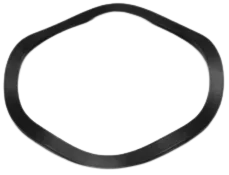
A wave washer is a flat ring that has been corrugated into a sinusoidal wave pattern around its circumference. When compressed, the waves flatten, providing a light, consistent spring force over a relatively large deflection range compared to a Belleville.
Standardised under DIN 137 (single-wave) with multi-wave variants also widely used. Size range: Ø6 mm to Ø100 mm.
Where wave washers excel
- Taking up manufacturing play - eliminating rattle or end float in bearing assemblies and housings
- Light preloading of bearings - especially in electric motors and small gearboxes
- Vibration dampening - the waves absorb shock and prevent loosening in light-duty applications
- Push-button and switch assemblies - providing tactile return force
Key characteristic: Wave washers are compliant. They deflect significantly under moderate loads, which makes them ideal for taking up dimensional variation - not for generating high clamping force.
Side-by-Side Comparison
| Property | Belleville (Disc) Washer | Wave Washer |
|---|---|---|
| Shape | Conical frustum | Corrugated flat ring |
| Standard | DIN 2093 | DIN 137 |
| Spring rate | Very high (stiff) | Low to medium (compliant) |
| Deflection per washer | Small (0.3–2 mm typical) | Larger (0.5–5 mm typical) |
| Load capacity | Very high (up to hundreds of kN) | Low to moderate |
| Can be stacked | Yes - series, parallel, or combined | Limited - stacking not standard practice |
| Typical applications | Flanges, bearing preload, valves, tooling | Motors, play take-up, light preload |
| Size range (Impex stock) | Ø6–Ø250 mm | Ø6–Ø100 mm |
Stacking Belleville Washers - Series vs Parallel
One of the most powerful features of Belleville washers is that their load-deflection characteristics can be tuned by stacking:
Series stacking (same orientation)
Washers nested inside each other all facing the same way. Each washer deflects independently. The result: same load as one washer, but deflection multiplies by the number of washers. Use this when you need more travel without increasing force.
Parallel stacking (alternating orientation)
Washers paired face-to-face and back-to-back alternately. The result: same deflection as one washer, but load multiplies by the number of washers. Use this when you need much higher clamping force in the same axial space.
Combined stacking
A combination of series groups and parallel pairs gives independent control over both load and deflection. This is the approach used in heavy-duty valve actuators and large flanged joints.
Wave washers do not benefit meaningfully from stacking and are normally used as a single element.
How to Choose
Use this decision framework:
- Need high clamping load (>5 kN) with minimal deflection? → Belleville washer
- Need to take up dimensional variation or end float? → Wave washer
- Thermal cycling environment where bolt preload must be maintained? → Belleville washer
- Light bearing preload in a motor or small gearbox? → Wave washer
- Need to fine-tune load and deflection independently? → Belleville stack (series + parallel)
- Need vibration dampening in a non-critical joint? → Wave washer
Need Spring Washers for Your Application?
We stock Belleville disc washers (DIN 2093, Ø6–Ø250 mm) and wave washers (DIN 137, Ø6–Ø100 mm) from Mumbai with same-week dispatch across India.
View Washer RangeFrequently Asked Questions
Can a wave washer replace a Belleville washer?
Not in most cases. Wave washers operate in a different load-deflection regime - they deflect significantly under relatively low loads. Belleville washers are designed for high load with very small deflection. Substituting one for the other without recalculating spring rate and deflection will almost certainly result in a design that is either too stiff or too compliant.
What does stacking Belleville washers in series do?
Stacking in series (all facing the same direction) increases total deflection while keeping the load the same as a single washer. Three washers in series triples the deflection at the same load.
What does stacking Belleville washers in parallel do?
Stacking in parallel (alternating, facing opposite directions) multiplies the load capacity while keeping deflection the same as a single washer. Two washers in parallel doubles the load at the same deflection.
What is the DIN standard for Belleville washers?
Belleville (disc) washers are standardised under DIN 2093. Wave washers are standardised under DIN 137 (single-wave). We stock both standards in carbon steel and stainless steel.